On 9 November, in a packed cinema in Turin, L’uomo delle stelle did something unusual: it put the people who normally work behind the scenes at the centre of the frame. Walter Cugno wanted to go to space. He never did. With his team, he helped build a home for those who do. This is more than a career story. The question now is whether Italy can design the systems needed to explore the Moon and Mars, with the same rigour that helped make orbit habitable.
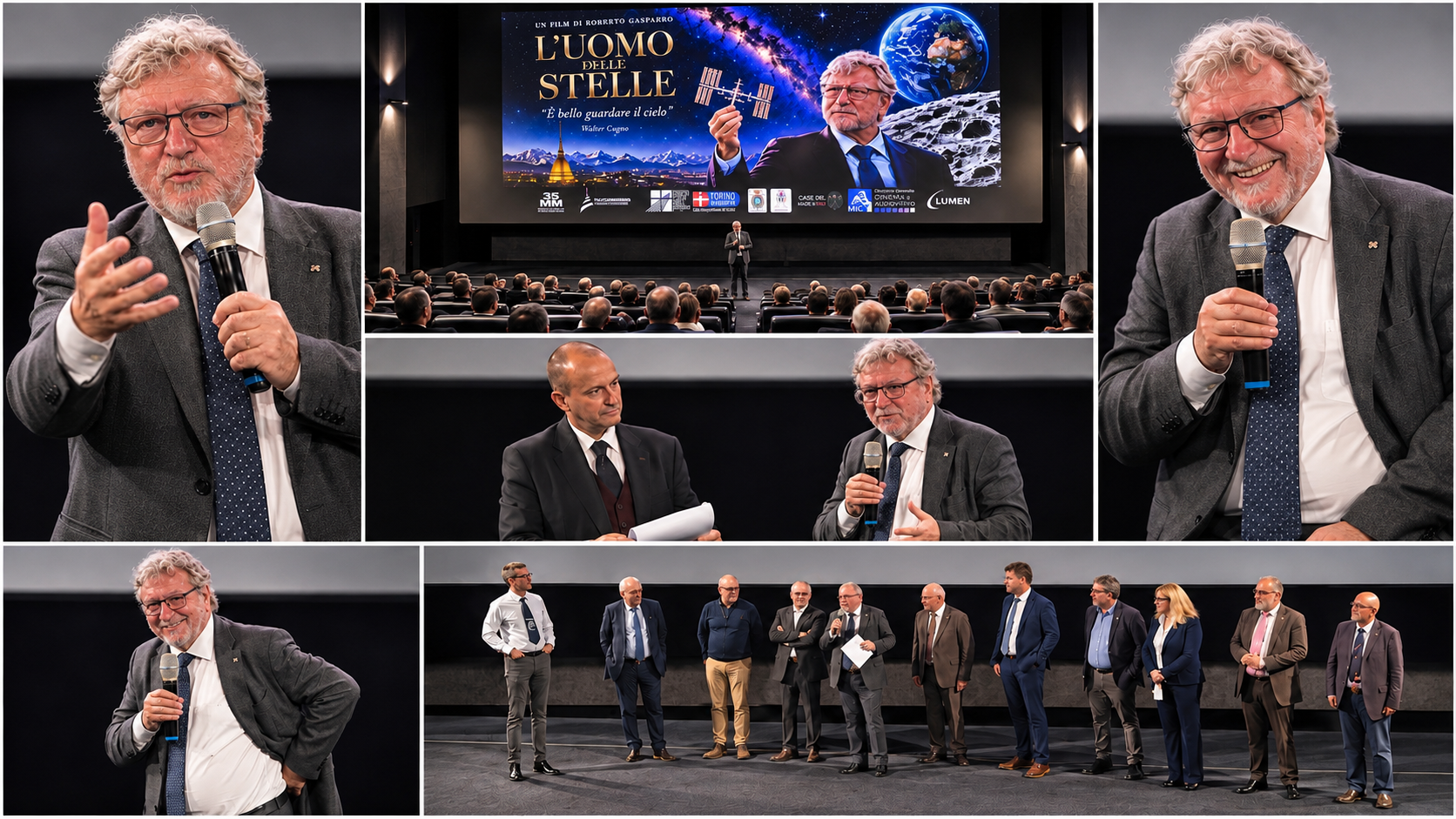
A packed cinema. At last, the builders take the spotlight
At Turin’s Massaua Cityplex, the 9 November premiere filled the auditorium. Then the lights went down. For once, the screen did not reveal another prophet of the “new frontier”, armed with a rendering and three slogans. It revealed an engineer. Around him stood a community committed to a discipline that is rarely cinematic but always decisive: in space, a design flaw cannot be fixed with a more impressive edit. That is the impression the film leaves: before the flags and the ceremonies come the people accountable for what they build.
The film has a central figure, Cugno, but wisely refuses to confuse its protagonist with the sole author of a collective achievement. Voices such as Roberto Angelini, Annamaria Piras, Silvia Castagneri, Ricardo Yague and Valter Costa bring that world to life, alongside systems specialists, technicians, programme leaders and quality experts. The film reveals a generation that helped Turin earn NASA’s trust. The names of those who board rockets are familiar; those who make sure the crew can return are much less so.
The documentary’s greatest revelation is not that engineers can make compelling cinema. It is that the human adventure of exploration requires a team before it requires a hero.
The boy who wanted to fly found a greater way to travel
Cugno had a precise ambition: he wanted to fly. A medical obstacle closed that path. Cinema knows what usually comes next: an impossible dream, swelling music, and an inevitable triumph. Reality is less obliging and more interesting. Cugno did not overcome a diagnosis by repeating an inspirational slogan. He changed course. From Aeritalia and Spacelab to the International Space Station and robotic exploration, he learned how to make other people’s journeys possible.
It is a more mature ambition than the kind sold at leadership conferences. Mass is real. Vibration is real. Oxygen must be there. The vacuum of space does not negotiate. Serious engineers do not pretend constraints are imaginary; they measure them, then work together to find a way through. Cugno’s story is not about the power of one exceptional individual. It is about a group that respects reality.
Harmony, Tranquility, Cupola: gentle names, unforgiving responsibilities
Harmony, Tranquility, Cupola. They sound almost like an ambient music album. In fact, they are crucial elements of the International Space Station: Node 2 links parts of the Station; Node 3 houses life-support functions; and the Cupola is the window through which astronauts observe Earth and monitor operations outside. Between 1997 and 2013, Cugno held programme responsibilities for these systems and related logistics activities. Behind the lyrical names sit pressure vessels, interfaces, qualification tests, anomalies and decisions that leave little room for romance.
Roberto Angelini remembers a telling episode. Before Harmony’s launch, six astronauts, among them Paolo Nespoli, came to Turin for fit checks: hands-on verification of the interfaces between humans, hardware and operational procedures. This was not a courtesy visit. The people who would work in orbit had to meet the engineers who designed what they would touch, in gloves, in a hostile environment. A handle, a joint, a clearance: international trust was measured there, too. In bolts, not flags in the background of a photograph.
On Earth, if a window is badly installed, you call the contractor back. The ISS has no such line in its service agreement. And yet the Cupola is also a remarkable metaphor: Italian engineering helped change the vantage point from which humanity sees itself. There can be few more tangible definitions of exploration.
Space cooperation is not a photograph with flags. It is an interface that works when nobody can afford a mistake.
Cugno’s open door is worth more than a leadership handbook
One image recurs in the testimony: an open door. Roberto Angelini uses it to describe Cugno’s approach. A leader who listens is not being soft; he is trying to find the defect while there is still time to fix it. In a system designed to keep human beings alive, the newest engineer may be right and the programme director wrong. A manager who silences disagreement has not created discipline. He has created risk.
The programme’s history offers a harder lesson. On 1 February 2003, the Space Shuttle Columbia broke apart during re-entry, killing seven astronauts. Angelini has recalled being in Houston at the time. This tragedy must never be used as a narrative stunt. It is a reminder of the human responsibility behind every technical decision. Trust is not smiling for a group picture. It is knowing that a critical concern can be voiced before the consequences become irreversible.
The documentary belongs in a business school as a case study, not as an inspirational interlude before the reception. The useful question is not the exhausted “How do you become a leader?” It is far more uncomfortable: what happens when a young engineer demonstrates that the chief executive is wrong? If the answer is to convene a committee, aboard a pressurised module the problem is no longer merely organisational. It is a safety risk.
Space Cowboys: the sequel must be written by the young
The story has an unexpected counterpoint in Clint Eastwood’s Space Cowboys. In that film, veterans are summoned because their successors no longer know how to control a system. On screen it is amusing. For an industrial nation it should be alarming. If the only way to understand why a valve was designed in a particular way is to locate the last retired engineer, age is not the problem: the memory of the design has been lost.
Cugno deserves better than becoming the last keeper of knowledge displayed behind glass. He deserves successors: young people with the opportunity to learn, make mistakes safely, take responsibility, sign drawings and lead teams. Great mentors do not seek to make themselves indispensable. Their achievement is to make their own constant presence unnecessary.
The story could sustain a major ensemble feature film, with Turin, NASA, the Shuttle era and the faces that rarely make it onto posters. Yet Gasparro’s documentary has the merit of opening that door without waiting for a Hollywood cast. The next generation now has to walk through it.
From a home in orbit to the Moon: the common thread is people
Exploration does not begin again from nothing whenever a programme changes its name. In 2026, Artemis II took four astronauts around the Moon. Orion relied on the European Service Module for propulsion, electrical power, water, air and thermal control. Its main structure was built in Turin by Thales Alenia Space, with Airbus responsible for integration in Bremen. A new journey, a different distance, but the same chain of competencies, stretching from the workshop floor to mission control.
It would be wrong to attribute all the work of those who followed Cugno to Cugno himself. That would contradict his lesson. An industrial school has truly succeeded when it no longer depends forever on its founder. If the knowledge behind the Cupola helps support the systems that carry exploration towards the Moon, the legacy is not a trophy on the wall. It is a living capability.
Cugno also led ExoMars in the field of robotic exploration. Here is the film’s most beautiful bridge: building a home for human beings in orbit and creating machines that pursue knowledge on Mars are expressions of the same vocation. To explore is to step into the unknown without pretending physics can be persuaded. Everything else, however inspiring, is science fiction.
The Moon does not read press releases. Nor does the future grant extensions
The ISS story is so extraordinary that turning it into an anaesthetic would be a mistake. In 2026, NASA paused Gateway in its planned form in favour of a stronger focus on the lunar surface. ESA is studying how previously developed contributions can be put to use. That does not mean exploration has stopped. It means exploration changes. Architectures shift, requirements are rewritten, and people who genuinely know their craft must be ready to adapt, rather than treating last year’s conference presentation as an immutable law of nature.
Argonaut offers a very tangible test. This European system is intended to deliver cargo to the lunar surface, with Thales Alenia Space in Italy leading the consortium for its descent element. Here, “being European” is not a branding exercise. It means holding design authority, integrating systems, verifying performance and delivering hardware. It means owning the outcome, not merely appearing in the family photograph.
The contrast is almost irresistibly ironic: the Moon does not read press releases, attend roundtables or grant another launch window because the panel on “vision” drew an excellent audience. It demands vehicles that arrive, instruments that work and systems that survive. The method portrayed by the documentary makes the point without borrowing the jargon of “execution”: test first, promise second.
Turin and Europe: staying on the map is not the same as owning the design
The same question hangs over industrial restructuring. BROMO, like any proposal for European consolidation, makes sense if it strengthens the ability to design, compete and carry system-level responsibility. If Turin kept its sign on the factory gate but lost technical authority, the result would resemble a magnificent exercise in industrial museum-making: dazzling on the render, dispiriting on the shop floor. A factory is not strategic simply because it still appears on a map. It is strategic when it can decide, design and deliver.
That also requires a supply chain: RF specialists, materials, mechanisms, electronics, software, environmental tests and qualification, including smaller companies that solve difficult engineering problems. Above all, it requires the continuity of skills. A country that can inaugurate everything but lets someone else sign the crucial design decisions may become world-class at one thing: opening ceremonies. That is not a programme of exploration.
Cugno’s message begins when the cinema lights come back on
On the film’s official website, Cugno’s philosophy is distilled into a simple sentence: “The purpose of our lives is to know.” It is not an invitation to sit back and contemplate. It is an ethic of doing: explore, doubt, cooperate across borders, allow evidence to challenge your enthusiasm. Then pass on what you have learned, so that the next generation can travel further.
Turin, 2035. In an imagined industrial foyer hangs a magnificent photograph of the Cupola. A few steps away, however, a young engineer should be able to show the drawings they are signing for a lunar mission, the qualification campaign still to be completed, the team to whom they are accountable. If only the photograph remained, the memory would be safe. The industrial future would not.
When the lights come back on at the Massaua, the feeling left behind is not nostalgia for a vanished golden age. It is a sense of urgency about preserving what made that achievement possible. The film gives a face to those who build, make mistakes, correct them and begin again. L’uomo delle stelle does not erect a monument to Walter Cugno: it captures a method of listening, testing and taking responsibility whose value depends on passing it to the next generation.
Cinema is allowed to roll the end credits. Exploration is not. The real sequel to this film will not be another ceremony. It will be designed, tested and launched. And, one day, someone will live inside it.
L’uomo delle stelle, directed by Roberto Gasparro and produced by 35MM Produzioni, premiered in Turin on 9 November 2026. According to the film’s official website, it will be available to stream on LumenTV from 25 December 2026.
Sources and further reading
- CorCom — review of the documentary and Cugno’s leadership approach
- 35MM Produzioni — official website for L’uomo delle stelle
- 35MM Produzioni — 9 November Massaua premiere report
- 35MM Produzioni — the voices and interviews behind the film
- Massaua Cityplex — documentary listing and screenings
- RAI TGR Piemonte — Cugno, Turin and the documentary
- Italian Space Agency — Italy’s contribution to the ISS
- Italian Space Agency — Node 2 Harmony
- Italian Space Agency — Node 3 Tranquility
- Italian Space Agency — the ISS Cupola
- NASA — remembering Columbia STS-107
- ESA — Artemis II and the European Service Module (2026)
- ESA — European Service Modules made in Italy
- ESA — ExoMars and robotic exploration
- ESA — Gateway Lunar I-Hab and the 2026 update
- ESA — Argonaut industrial consortium
- CorCom — BROMO, governance and industrial responsibility
Editorial assessment as at 12 November 2026. Pausing Gateway in its original form does not automatically cancel the industrial contributions already developed.